
On the face of it, parking policy isn’t very sexy. There’s talk of car rotation for residents and shopkeepers, there’s talk of paid parking for the same purpose, and there’s talk of residents’ monthly subscriptions. And yet…
In Lyon, we are committed to a global strategy for the mobility transition in order to better share public space and combat climate change, air pollution and improve road safety. Parking policy must be fully integrated into these challenges!
In Lyon, we have decided to make this an integral part of our overall strategy since 2020. This intensive work by the Urban Mobility Department has resulted in a new progressive parking fee, which is divided into three parts:
- Simpler pricing for professionals, in particular craftsmen
- Family and solidarity pricing for residents
- Progressive pricing based on the duration, engine and weight of vehicles
Simplify for professionals

The existing « Pro Santé » scheme is a good one, but it will be extended so that more care professions can access the preferential on-street rate : care assistants, veterinary emergencies, osteopaths, etc.
As for the various types of craftsmen, they are essential to the smooth running of the city, with major logistical challenges (so-called « workshop vehicles »). They are currently experiencing difficulties. We are therefore going to simplify what already exists and create new offers.
The current « Pro dépannage urgent » scheme will become an annual subscription scheme with a single rate for the whole year – as opposed to an annual fee at present, followed by virtual ticket-taking on a daily basis. Once again, the idea is to simplify things: no need to take a ticket every time!

We are creating a new scheme called « Pro chantier ». The aim is to create preferential pricing for a greater number of building and civil engineering contractors, rather than just for urgent repairs, to simplify their journeys around town and reduce costs for their customers – the « parking surcharge » is a thing of the past.

Finally, the economic policy of the City and Metropolis is to encourage craft and production activities, including in the heart of the Metropolis. In fact, a number of them have obvious logistical needs in terms of delivering to their workshops or shops, supplying professional or private customers, and so on. We are creating the « Pro artisan-commerçant » scheme, which will enable these craftsmen to park a utility vehicle (N1) in the resident sector corresponding to their business.
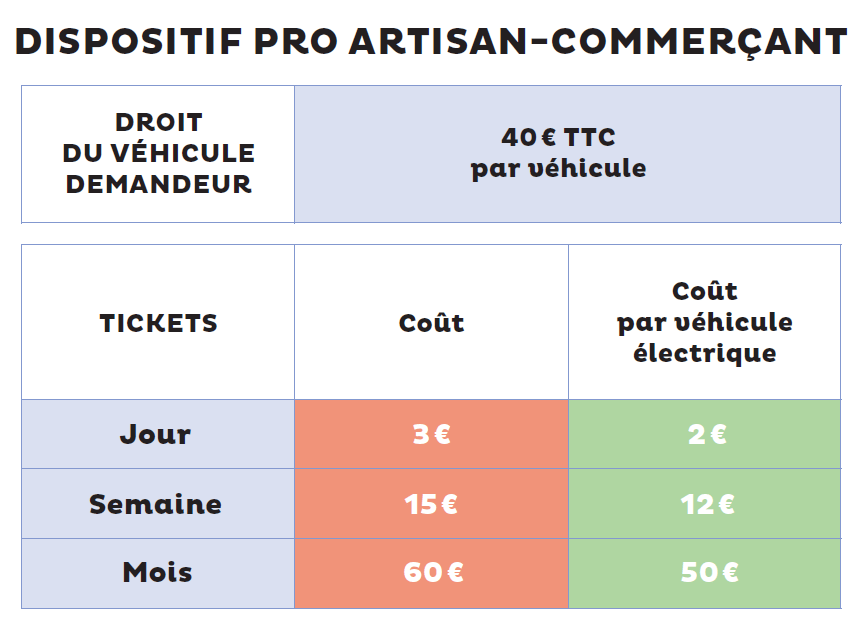
These three schemes systematically include a preferential rate for electric commercial vehicles compared with combustion-powered ones. It’s common sense when you consider our need to decarbonise the logistics sector!
A family and solidarity fee for residents
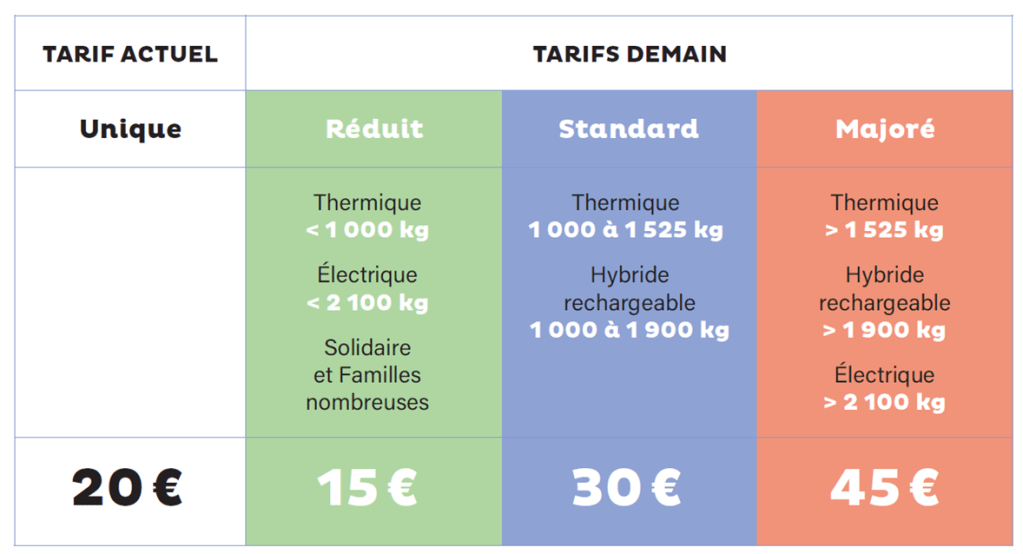
When devising public policies, it is essential not to see society as a black box that masks the different realities within the population. The new progressive pricing system will therefore be fairer! Families on the lowest incomes (brackets 1 to 3 of the municipal family quotient, i.e. currently an annual income per unit of less than €13,800) and large families (3 or more dependent children) will be entitled to a reduced rate of €15 per month (compared with €20 at present).
This family and solidarity fare will benefit around one household in two and around 60% of families in Lyon.
Integrating car engines and weight
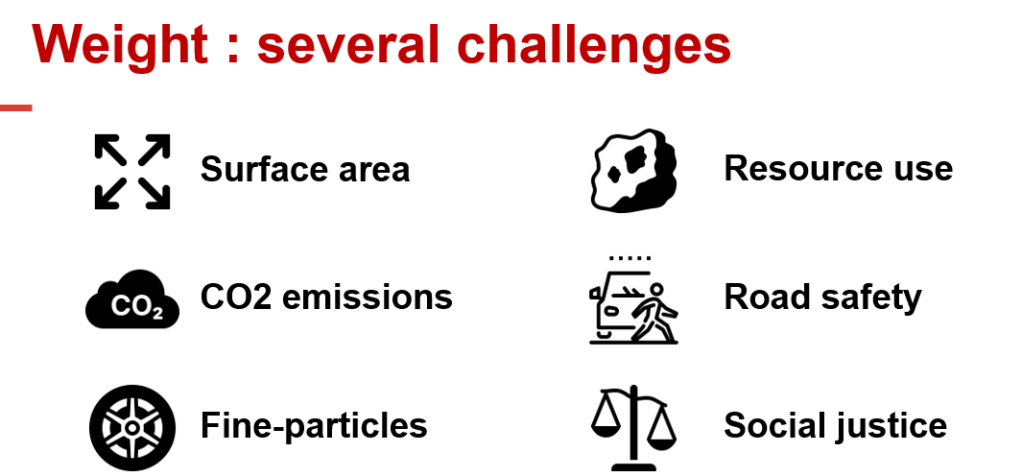
As we have said, parking policy must be fully integrated into the mobility transition. We will be introducing a progressive on-street parking pricing based on the overall impact of vehicles on the environment and the occupation of public space. The aim is still to encourage rotation in the city, with a reduced rate for electric vehicles and a reduced or increased rate based on weight.
As part of the transition in mobility, we are seeing a shift in motorisation towards more electric vehicles. Our cities are suffering from air pollution. Over the next few years, we need to step up our efforts to improve air quality. For those who need to use a vehicle, electric is one of the solutions. That’s why they automatically benefit from the reduced rate for both residents and visitors.
There is one exception to this rule, given that the recent trend has unfortunately been for certain brands to build very heavy electric vehicles (so-called « electric tanks »): particularly bulky electric cars weighing more than 2,100 kg.
We have added a further criterion: the weight of the vehicles. Why is this? A number of factors have led to this conclusion: issues of public space, air pollution, CO2 emissions, safety and so on. The French Citizens’ Climate Convention sums it up best [1] in its report:
Heavier vehicles have a much greater impact on the climate: they consume more fuel, require more materials to build and, in the case of electric vehicles, have much larger batteries. and, in the case of electric vehicles, much larger batteries. In addition, heavier vehicles have a number of other externalities: the accidents they cause are more serious (particularly in the case of tall vehicles such as SUVs, whose bumpers are at the level of pedestrians’ vital organs), braking emits more fine particles, and they take up more public space, to the detriment of other, less polluting modes of transport.
Convention citoyenne pour le climat
to the detriment of other, less polluting modes of transport.
In recent years, the weight of vehicles has increased dramatically… Why is this? This is partly due to safety equipment, but more to an increase in vehicle size and comfort equipment. In fact, it’s mainly due to the purchase of larger vehicles.
Part of the increase in weight is due to changes in models over the years: an increase in size, safety equipment and comfort.
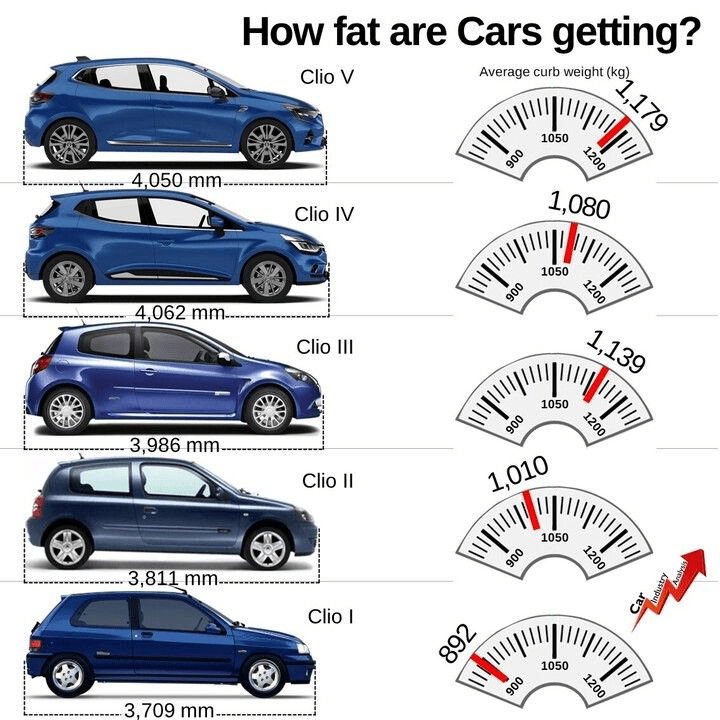
However, this is not about the Renault Clio, which remains a small city car, and a sober one at that. What we are seeing is a transition in car segments [2]: fewer city cars, more large vehicles. The overall increase in weight is therefore much more significant!
This shift in segments towards larger cars is no accident. It is also a direct result of advertising. A WWF 2021 report [3] sets out the facts eloquently: 3 hours and 50 minutes of TV advertising for large « SUVs » every day in 2018 and 2019 – that’s 2 football matches a day!
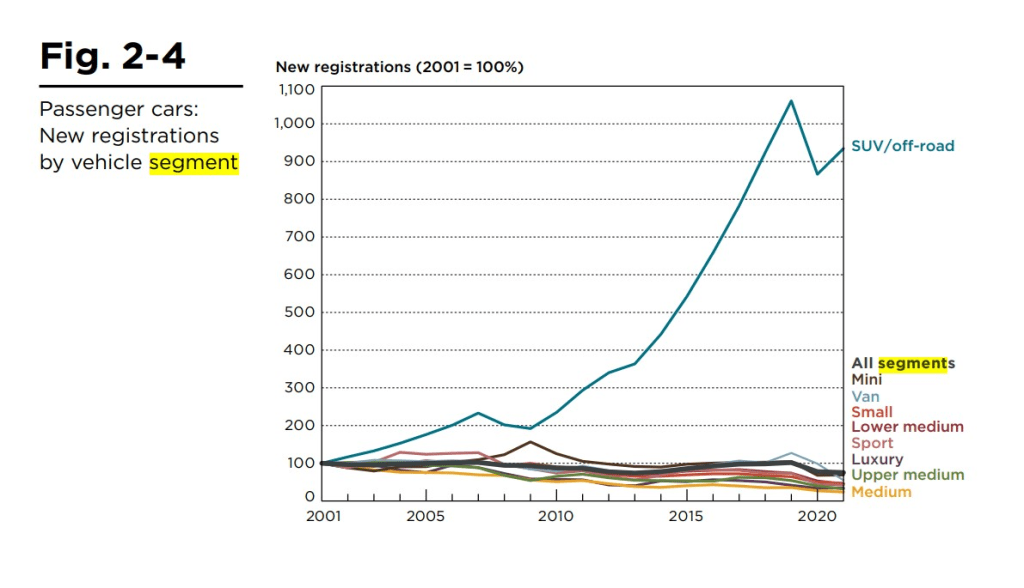
Moreover, while the overall increase in weight is not so much linked to safety equipment, in fact safety is actually being degraded as a result of this trend. According to an AXA 2020 study [4], the bigger and heavier the vehicle, the higher the frequency of collisions. « SUVs cause 10% more accidents; large SUVs even 27% more accidents ». The result is a relative increase in safety for the driver, but not for other road users.
Note that a Renault Clio has a 5-star NCAP rating without needing to weigh 2 tonnes.
More weight also means a larger body. So it’s also a major issue in terms of taking up public space, given that public space is still not expandable. Parking spaces are not expanding, and neither are underground car parks, private or public. In Lyon, parking is counted in lines, so the number of spaces available is actually not the same if the majority of cars are Clios or X5s.
The increase in weight is also an aggravating risk for air pollution. Fine particle emissions come increasingly from the abrasion of tyres, road surfaces and brakes. Here again, the cause is the increase in weight [5]. An air pollution issue confirmed in April 2022 by French Ademe [6]: 59% of fine particles come from the abrasion of tyres, road surfaces and brakes.
Electric vehicles must also become lighter. There is a trend towards electric cars that have a particularly high impact. If the priority over the next few years is the electrification of the car fleet, let’s avoid creating yet another problem with this transition. The circulation of « electric tanks » will not solve much of anything, and we can see that sober electric vehicles can exist and perform perfectly well.
It is therefore essential to combine the electrification of the fleet with other measures, including making vehicles lighter.
ADEME
All of this work has led to the creation of a simple, relevant and progressive scale for parking rates. The 1525 kg threshold is the unladen equivalent of the 1600 kg (in running order) set out in the 2024 Finance Act. The 1900 kg and 2100 kg thresholds are equivalent for the same vehicle size. The 1000 kg threshold sets a clear limit for small city cars.
For residents, here are the monthly rates with the solidarity and family system for large families and households on the lowest incomes.
As far as visitors are concerned, the message is clear: it may still be necessary to use a car on a daily basis. There’s nothing to worry about! Collectively, so that everyone can take part in the mobility transition, it’s worth setting ourselves some shared guidelines: making maximum use of car-sharing – optimising the associated energy consumption, preferring electric cars – with lower CO2 emissions, preferring light, fuel-efficient cars – with lower CO2 and fine particle emissions, and less consumption of public space (in the city centre) and resources.
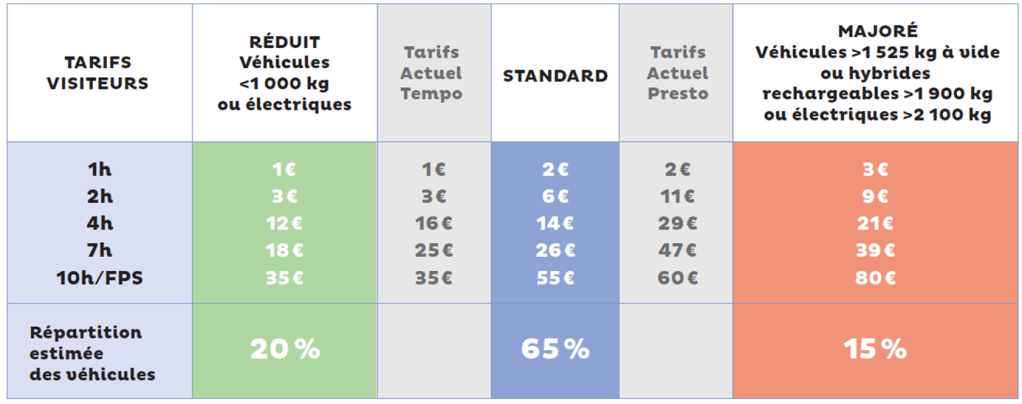
Subject to the City Council’s approval of these terms and conditions, all these new fares will be implemented by June 2024. Once the vote has been taken, targeted and general communications will be launched by the City of Lyon. A simulator will also be available on lyon.fr.
Sources:
[1] https://www.conventioncitoyennepourleclimat.fr
[2] https://www.jato.com/h1-2022-europe-by-segments/?from_newsroom=true
https://theicct.org/wp-content/uploads/2023/01/ICCT-European-Vehicle-Market-Statistics-Pocketbook_2022_23.pdf
[3] https://www.wwf.fr/sites/default/files/doc-2021-11/20210325_Rapport_Le-trop-plein-de-SUV-dans-la-publicite_WWF-France.pdf
[4] https://www.axa.ch/fr/ueber-axa/blog/mobilite/axa-crash-tests-recherche-accidentologique-suv-trottinette-electrique.html
[5] https://www.theguardian.com/environment/2022/jun/03/car-tyres-produce-more-particle-pollution-than-exhausts-tests-show
[6] https://media.roole.fr/quotidien/au-volant/particules-fines-59-des-emissions-ne-proviennent-pas-de-lechappement
Références:
https://www.lyon.fr/mobilites/le-stationnement
http://cartes.lyon.fr/stationnement-resident-voirie/
 Valentin Lungenstrass